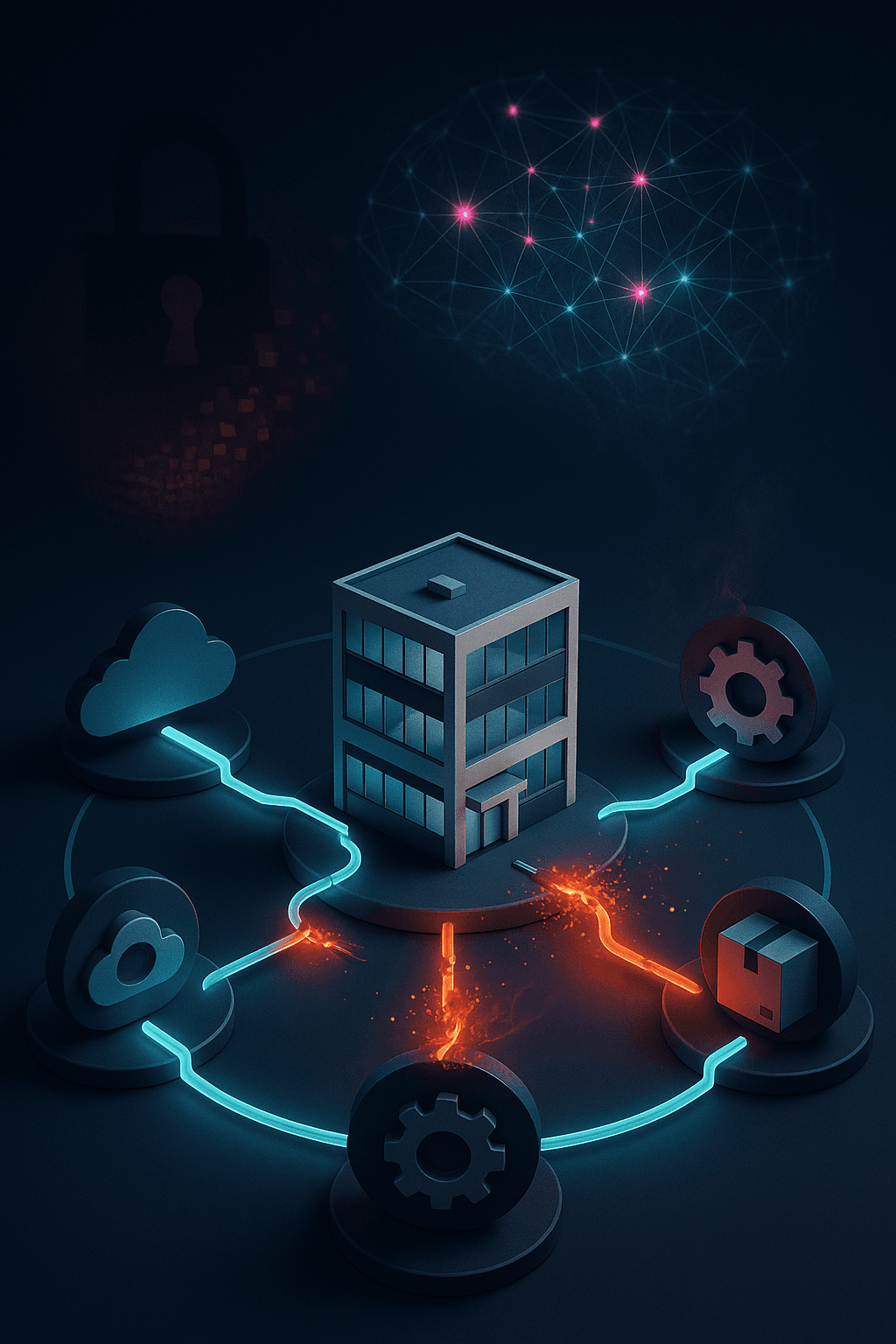
In 2026, B2B cybersecurity is no longer just an IT issue. It’s a continuity-of-operations and revenue-loss issue. The most profitable attacks for threat actors no longer target only your company: they target your ecosystem — vendors, SaaS tools, open-source libraries, and integrations. And AI is increasingly part of the equation… often without guardrails, because “everyone is testing an LLM in their corner.”
If you lead an SME or run an IT organization with a highly connected stack (CRM, ERP, ticketing, BI, automations), three threat vectors are rising fast: software supply chain (compromised dependencies), hybrid ransomware (DDoS + exfiltration + legal pressure), and chaotic AI governance (autonomous agents/MCP, unapproved tools, voice cloning).
The SME Opportunity
Good news: SMEs can regain the advantage — not by buying “one more tool,” but by making attacks less profitable and incidents less paralyzing.
- Audit to reduce incident cost: risk mapping, vendor assessments, vulnerability scans and a few targeted penetration tests often reveal open doors (dormant accounts, exposed secrets, unmonitored dependencies) before attackers exploit them. Direct ROI: fewer outages, fewer on-call escalations, fewer panic-driven restores to production.
- Turn security into a commercial differentiator: B2B buyers are raising the bar (security questionnaires, contract clauses, proof of maturity). Impeccable GDPR compliance and, for many organizations, a path to ISO 27001 become sales accelerators — not just administrative boxes to tick.
- Bring order to AI before it creates chaos: clear LLM policies, allowed/forbidden usages, and monitoring of data flows. The goal: prevent sensitive data from being sent to unapproved tools, or an AI agent (via MCP or similar) from executing high-impact actions on internal systems.
Vigilance
The classic trap in 2026 is believing a SOC/SIEM, SOAR, or MDM/UEM will magically solve the problem. These building blocks are powerful but complex: they require skills, time, and ongoing tuning (otherwise they become dashboards that flash without actionable outcomes).
Another risk: AI haste. Deploying autonomous agents or copy-pasted code without security and legal validation can inadvertently expose your infrastructure. Even with good internal hygiene, supply chain dependency is asymmetric: one compromised vendor can contaminate dozens — or thousands — of companies.
Finally, expect upfront costs: external audits, team upskilling, procedure formalization, and possibly an ISO program. It isn’t free — but it’s often far cheaper than a week-long outage plus a data leak and a client-relations crisis.
Compliance Snapshot
GDPR (EU) and the Swiss nLPD are both legal and commercial issues. Concretely, you’re expected to deliver:
- Documented, auditable processing: protection of customer databases, retention rules, and an incident response plan (who does what, when, and how notifications are handled).
- Control over subcontractors: DPAs, security assessments, and alignment between contractual requirements and on-the-ground reality.
- AI under control: a personal ChatGPT, a cloned LLM, or a voice-cloning tool without contractual and technical constraints can create a breach (uncontrolled transfers, opaque retention, inadvertent disclosure).
On hosting, depending on your flows and constraints you may need to choose between options like AWS Local Zone/Region (Paris/Zurich) or providers such as Exoscale, Infomaniak, OVH, Scaleway, Hidora to align data locality, contracts and security levels. The key point: know where your data travels and who can access it, especially when the supply chain is under attack.
Conclusion & Cohesium Support
In 2026, B2B cybersecurity rests on three levers: reduce your supply chain attack surface, make ransomware less destructive, and apply a simple but firm AI governance to prevent wild tooling.
Instead of patchwork fixes, Cohesium AI can support you with:
- Strategy & AI Audit + Compliance & Data: mapping LLM usage, assessing risks from agents/MCP, and a GDPR/nLPD-oriented cybersecurity audit (third parties, data flows, incident response, hosting).
- Automation: implementing continuous-audit workflows (e.g., n8n/Make) to monitor open-source dependencies, vendor alerts, and to orchestrate your existing SIEM/SOAR signals.
- Custom development (optional): AI agents for behavioral analysis and anomaly detection, designed to limit exposure when external LLMs are involved.
Contact us to discuss custom integrations or a strategic audit tailored to your business needs.