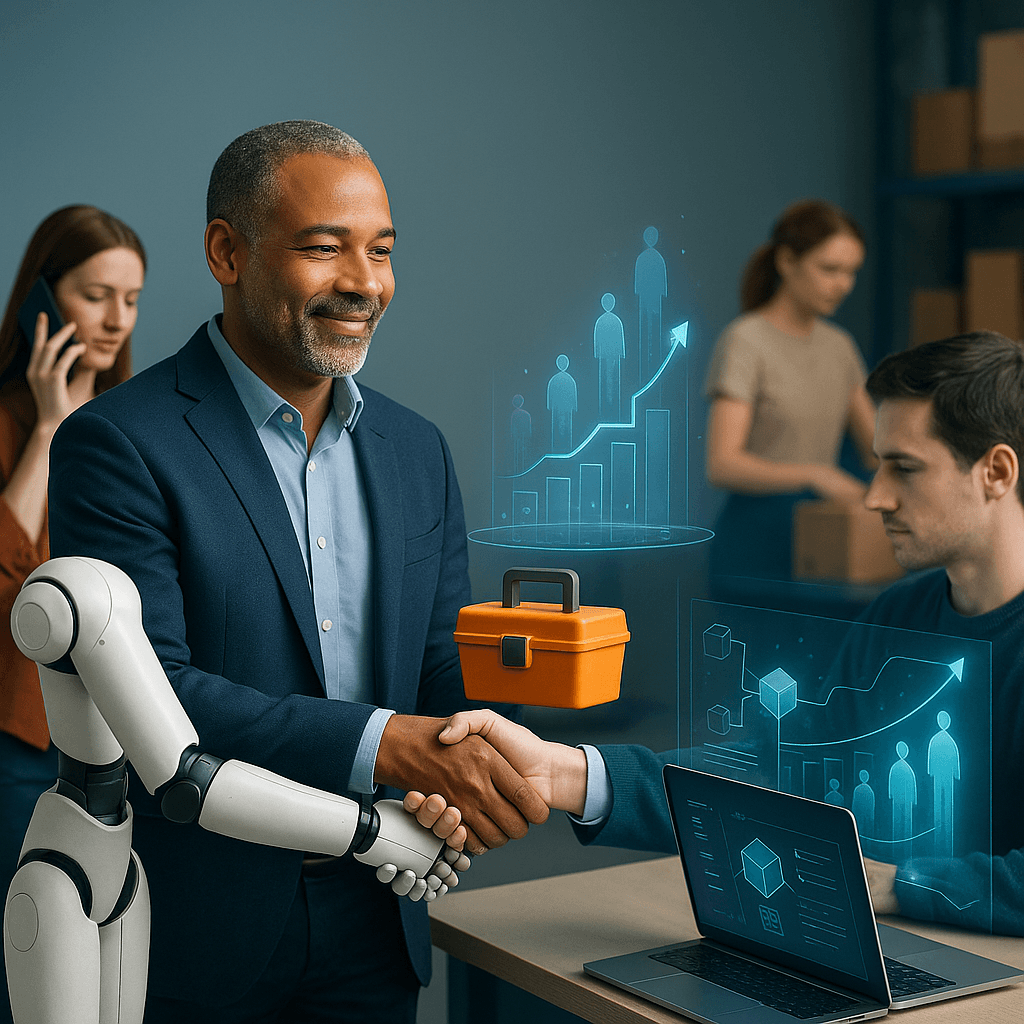
In popular imagination, “digitize” often equals “automate” and then “cut jobs.” B2B is delightfully different: it remains intensely human. According to reporting in Opinion Internationale (Feb 23, 2026) quoting Fabien Prêtre (Fulfiller), the French B2B e‑commerce market was about €400 billion in 2024 (FEVAD/JDN). If 25% of that market migrated to digital platforms (≈ €100 billion) and if the operational ratio holds at roughly 1 job per €1M of incremental revenue for client relations and logistics, we’re talking about a potential of 100,000 new jobs.
Is that a prophecy etched in stone? No. But for an SME B2B leader it’s a strong signal: digital transformation does not have to be a payroll-cutting machine. Done well, it’s a lever to sell more, serve better… and hire.
The SME Opportunity
The key point: B2B hasn’t finished its transformation. FEVAD data shows 42% of B2B buyers still transact by phone or email, and one in two orders involves spoken interaction. Business translation: customers don’t just want a “Buy” button — they want confidence, expert advice, tailored adjustments, and reliable lead times.
So when you deploy a customer portal or B2B e‑commerce site, you’re not replacing commercial relationships — you’re shifting them toward higher‑value work. Typical shifts include:
- Augmented customer support: less manual data entry, more proactive follow‑up and account care.
- Product expertise: recommendations, equivalents, configurations, compatibility checks and curated bundles.
- Logistics oversight: keeping delivery promises, traceability, returns and dispute management.
In short: digital tools let you absorb higher volume without turning your team into a stressed call center. When volume truly scales, the question becomes not “who do we cut?” but “who do we hire to fulfill the customer promise?”
Where to Stay Vigilant
Before you print “100,000 jobs” on a mug, stay pragmatic. That estimate rests on a single migration assumption (25%) and a ratio (1 job / €1M) that varies widely by industry, margin profile, average order size, automation level, and logistics complexity.
Another blind spot: the transformation costs. In real projects, digitizing a B2B journey usually means:
- ERP/CRM integrations,
- cleaning the product master data (that terrifying “Excel catalog”),
- customer‑specific pricing rules,
- and change management (or your team will bypass the tool).
And remember the classic bias: Fulfiller is a market player (they claim €10M cumulative revenue over 3 years), so optimism is natural. That’s not illogical — it means you should run the project with clear scenarios (low/medium/high) and a realistic timeline, not marketing slogans.
Conclusion
For an SME B2B company the question is no longer “should we digitize?” but “how do we digitize without breaking what sells: relationships, responsiveness, and trust?” The potential is real: more revenue, better service quality, and likely new hires — provided you anticipate costs, integrate systems correctly, and align organization and processes.
Contact us to discuss a strategic audit or a custom integration plan that preserves your commercial craftsmanship while scaling operations.