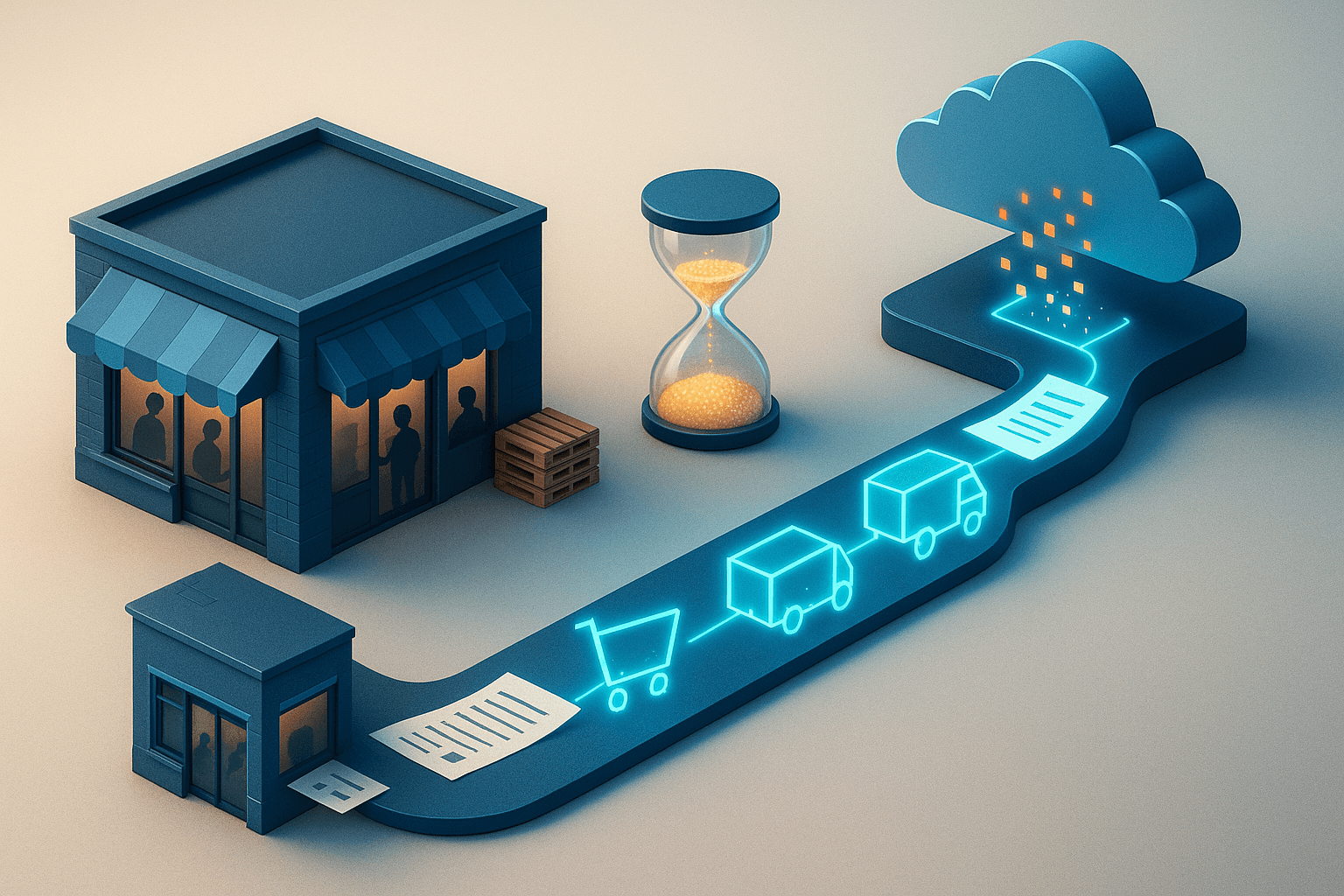
B2B e‑commerce in France is a large engine still idling: the market exceeds €400 billion (2024) and credible estimates point to roughly 25% of that volume (≈€100B) that could migrate to higher‑performing digital platforms. Translation for an SME: your professional customers will get used to ordering “like on Amazon”… but with far more complex requirements around pricing, terms, delivery and invoicing.
And this is not just a website project: it’s a reinvention of the order → delivery → invoicing → support cycle. Done well, it boosts margin and retention. Done poorly, it creates operational crises when everyone digitizes at once.
The Opportunity for SMEs
1) Automate cash flow and your teams’ time
In B2B, friction is expensive: manual order re‑entry, reminders, SKU errors, disputes over negotiated pricing. A well‑chosen B2B SaaS stack (catalog, orders, inventory, tracking, after‑sales) removes invisible labor and frees your staff to focus on revenue drivers: negotiation, upsell, and retention.
2) Ride a market that’s accelerating
French B2B e‑commerce is forecast to grow (~8.41% annually through 2031). Digital platforms and customer journeys become acquisition channels in their own right. If competitors are still sending PDFs by email, you can outpace them on processing speed and service quality — and convert that into higher repurchase rates.
3) Get ahead of mandatory e‑invoicing
On September 1, 2026, B2B electronic invoicing becomes mandatory in France. Early adopters will turn a compliance requirement into a competitive advantage: cleaner processes, fewer disputes, and controlled ERP/accounting integration. Latecomers risk a “panic project” — exploding budgets, rushed vendors, and reactive technical choices.
4) Build useful roles (not just “support”)
Macro estimates suggest significant employment impact on the service side (a rough empirical ratio: 1 job per €1M of incremental revenue). At your scale the logic is simple: as digital volume grows you need in‑house expertise in B2B customer service, logistics and order administration — but equipped with tools, not overloaded by manual tasks.
Risks & Guardrails
Don’t treat the 25% estimate as a guarantee. It’s an order of magnitude, not a business plan. Your sector can shift faster — or much slower.
Risk #1 — Vendor lock‑in. If a SaaS platform becomes the core of your commerce, negotiate from day one: data export, exit and reversibility clauses, availability penalties, and clear incident roles and responsibilities.
Risk #2 — Integration with legacy systems. ERP, CRM, WMS, special pricing and multi‑site accounts — the details live in the connectors. A fast go‑live that ignores edge cases turns into permanent double entry.
Risk #3 — Underestimating change management. Digitizing isn’t “installing a tool”; it’s evolving how you sell, bill and serve customers.
Compliance Snapshot
GDPR: Even in B2B you process personal data (contacts, emails, histories). A GDPR audit is recommended: DPA, retention periods, subprocessors, and transfers outside the EU if your SaaS relies on non‑European cloud providers.
B2B e‑invoicing (from September 1, 2026): ensure your solution supports French requirements (e.g., Chorus Pro / Peppol depending on chosen schemes). Best practice: contractually validate compliance, not rely on a sales slide.
Hosting: Based on your data sensitivity and client constraints, favor EU regions (e.g., AWS Paris/Frankfurt) or European sovereign providers such as OVHcloud, Scaleway, Exoscale, Infomaniak. This is not ideology — it’s risk reduction, legal and operational.
Conclusion & Cohesium Support
B2B e‑commerce is not just “opening an online channel.” It’s an opportunity to raise productivity, accelerate acquisition and arrive compliant for 2026. It’s also a risk if you let technology, integration and compliance dictate choices instead of the reverse.
Rather than patching things together, Cohesium AI helps with a four‑pillar, craftsmanship approach:
(1) AI Strategy Audit: review your B2B roadmap and advise platform selection.
(2) Automation: implement order/invoice/support workflows via n8n or Make.
(3) Compliance & Data: GDPR audit + 2026 e‑invoicing readiness check + hosting recommendations.
(4) Development: an AI support agent for B2B (RAG over your documentation) plus a commercial chatbot.
Entry point: a 1–2 week audit, followed by a typical 3–6 month deployment roadmap depending on scope. If you prefer a tailored path — from custom integration to strategic audits — contact us.