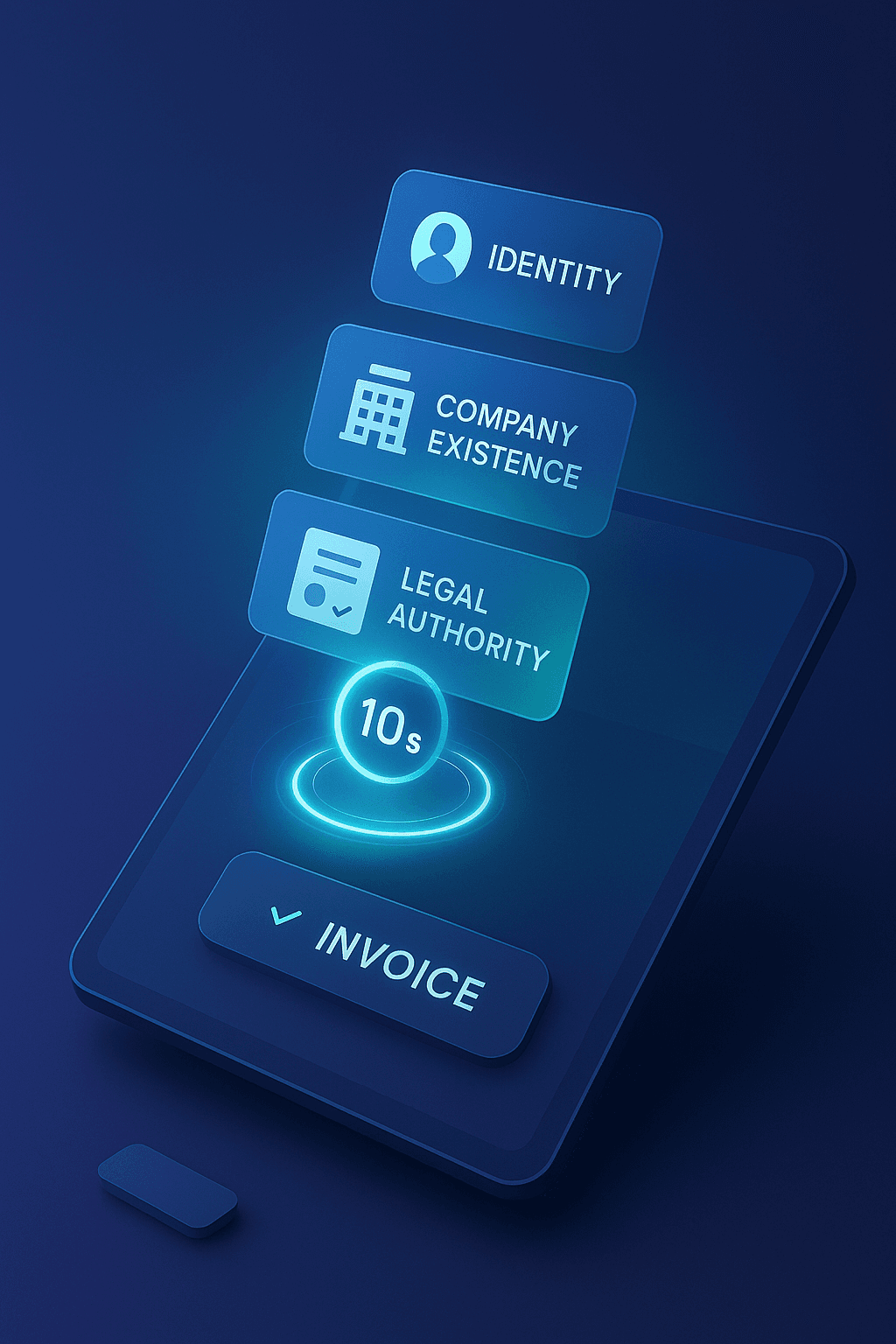
If you sell B2B, you know the awkward moment: the cart is ready, the customer chooses “invoice,” and you must… wait. Wait for company validation, a credit check, and the more insidious question: does the person in front of you actually have the legal authority to bind their company? Two (fintech) and Signicat (digital identity) tackle this head-on with an integration designed to perform that verification in real time.
Put simply: fewer pending orders, fewer document back-and-forths, and a smoother B2B “buy now, pay later” experience — without turning your finance team into investigators.
The SME Opportunity
The key issue is what Two calls the “authorization gap”: verifying an identity (eID, biometrics, document checks) and scoring a company is now fairly standard. But proving that “Alice at X” has signing authority for “X” is often artisanal: company registration extracts, articles of association, delegation letters, email confirmations, follow-ups… and it kills momentum.
With the Two + Signicat approach, the goal is to validate in a single flow:
- the person’s identity (national eIDs and/or document verification),
- the company’s existence through official registries,
- legal authority (the ability to represent the company).
From a business perspective, the ROI is concrete:
- Shorter sales cycles: move from “several days” to “seconds” on account set-up / invoice payment terms.
- Fewer drop-offs: every friction at checkout costs margin and conversion.
- Lower finance workload: fewer manual checks so your team focuses on real risk cases.
- Reduced fraud: fintech sees rising fraud, and B2B is an attractive target as average order values grow.
In a market where B2B e‑commerce is projected at ? trillion by 2026, those who streamline order capture and credit approval will win market share. You don’t have to be Amazon to benefit.
Practical Caveats
As always, the devil is in coverage and execution:
- Registry coverage: access and data quality vary by country. Is your business single‑country or multi‑jurisdictional?
- Non‑standard cases: holdings, subsidiaries, temporary delegations, proxies… if you serve complex corporate clients, expect exceptions.
- AML/KYC: integrations may include basic checks, but your obligations depend on sector, geography and your risk policy.
- Pricing: not published. Costs often hide in volume tiers, country coverage, advanced checks and manual fallback.
Practical advice: don’t rebuild your entire checkout at once. Pilot on a segment (new customers, baskets > X, 30‑day payment terms) and measure two KPIs: conversion rate and DSO (Days Sales Outstanding).
Compliance Considerations
We’re handling identity data and person–company links, so you’re squarely in GDPR territory (and Switzerland’s nLPD if you operate there). Key guardrails:
- Legal basis (contract / legal obligation / legitimate interest) for identity and authority verification.
- Minimization: collect only what’s necessary for credit/fraud risk assessment.
- Processors and transfers: where is data processed and who has access?
- Retention periods aligned with your obligations (disputes, AML/CFT, audit).
Conclusion
Two & Signicat address a concrete B2B bottleneck: as long as signing authority stays manual, instant credit remains either fantasy or risk. For SMEs and mid‑market enterprises, the goal isn’t to pile on tools: it’s to sell faster, collect cleaner and reduce disputes by industrializing what can be industrialized. If you want to explore a custom integration or a strategic audit to assess impact on conversion and DSO, contact us.