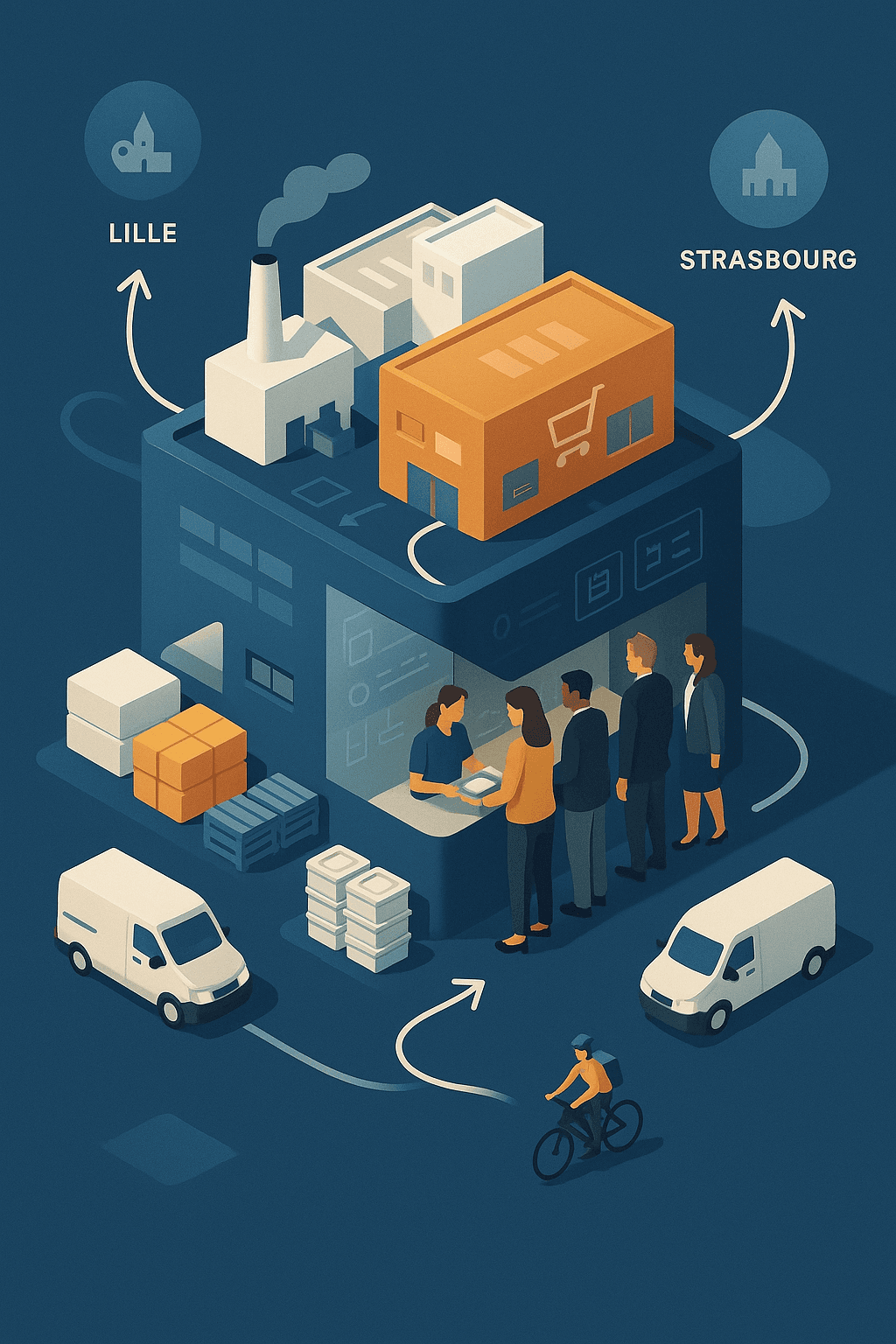
Class’croute is not simply "opening restaurants." The B2B brand (35+ years, 120+ locations) is structuring its 2026–2028 expansion around two regional hubs: Lille (several sites planned) and Strasbourg (a flagship plus a high-traffic location). The concept: "motherships" that combine production, logistics and retail to serve local companies across multiple formats — on-premise, delivery, 360° catering and a digital canteen (b'app). Think digital craftsmanship: robust, reversible integrations and predictable flows, not mass-produced one-off fixes.
If you’re an SME or mid-market leader, or the CIO/CTO operating in Hauts-de-France or Grand Est, this is a weak signal that can quickly become a concrete lever on office life (and therefore on workforce performance).
The SME Opportunity
1) A pragmatic answer to flex office and fragmented lunchtimes.
Partial remote work, overrunning meetings, scattered teams: lunch becomes a variable to manage. A digital canteen plus enterprise delivery, supported by regional logistics, can restore order: consolidated orders, reliable time slots, less wasted time, and a consistent experience even as headcount fluctuates.
2) A B2B caterer designed for operations, not just events.
360° catering isn’t only about boxed meals. For an SME it’s the ability to handle seminars, trainings, client visits or peak weeks without dedicating a full-time internal resource. Direct ROI: fewer logistical frictions, fewer surprises, a more professional image.
3) For franchisees and partners: network effect and shared digital tooling.
In theory, a unified ecosystem with CRM, loyalty programs and a digital canteen app improves repeat business, order frequency and commercial visibility. When the brand posts +4.3% growth in 2024 while the market fell (-2%), it’s at least worth a benchmarking exercise.
Risks to Watch
1) Technology transformation: possible turbulence.
Class’croute started a network architecture overhaul in 2024 and announced a technological transformation for 2025. On the ground that can mean temporary glitches in critical systems (POS, CRM, loyalty, ordering/app). If you rely on them to feed 30, 80 or 200 people, you need B-plans: documented processes, SLAs, support arrangements and incident reporting.
2) Omnichannel = hidden complexity.
Multisite setups, shared production, inventory, delivery, on-premise and digital channels work smoothly only when orchestration is disciplined. Otherwise you get stockouts, delays, "phantom" orders and billing mismatches. For IT, the attention point is clear: integration quality and data integrity — not marketing packaging.
3) Dependency on the ecosystem.
Proprietary tools (app, CRM, loyalty) bring coherence but reduce reversibility. For a franchisee that’s a governance question. For a corporate client it’s a continuity and data-control question: who owns the data, how portable is it, how quickly can you change providers?
Compliance Considerations
The digital canteen (b'app) collects data: identity, ordering habits, delivery details, company affiliation. That means GDPR must be addressed seriously: where is data hosted (EU/France?), retention periods, subprocessors, consent mechanisms and procedures for exercising rights (access/rectification/deletion).
Also monitor potential implications of the AI Act if recommendation or B2B targeting algorithms are introduced (not specified today). And if expansion to Switzerland is ever on the roadmap, the new Swiss Data Protection Act (nLPD) could become relevant.
Conclusion & Cohesium Support
The 2026–2028 plan is an ambitious territorial strategy: win proximity while industrializing omnichannel. For an SME, that can translate into real day-to-day comfort. For a CIO/CTO, it’s a reminder: when a service mixes digital and logistics, robustness across the entire flow (order → production → delivery → billing) is what separates reliable service from operational headaches.
Rather than patching things together, Cohesium AI can help with: (1) a technology transformation audit (architecture, CRM/POS/app/delivery integrations, stability and scaling roadmap), (2) automation of order–production–delivery workflows (n8n/Make and integrations), (3) a GDPR-focused audit for the digital canteen (hosting, subprocessors, retention, rights), and (4) practical AI components (ordering agents, B2B lead scoring, product recommendations via RAG) that add value without complicating operations. If you prefer craftsmanship over mass production, let’s discuss a strategic, reversible integration plan.
Contact us to discuss custom integrations and strategic audits