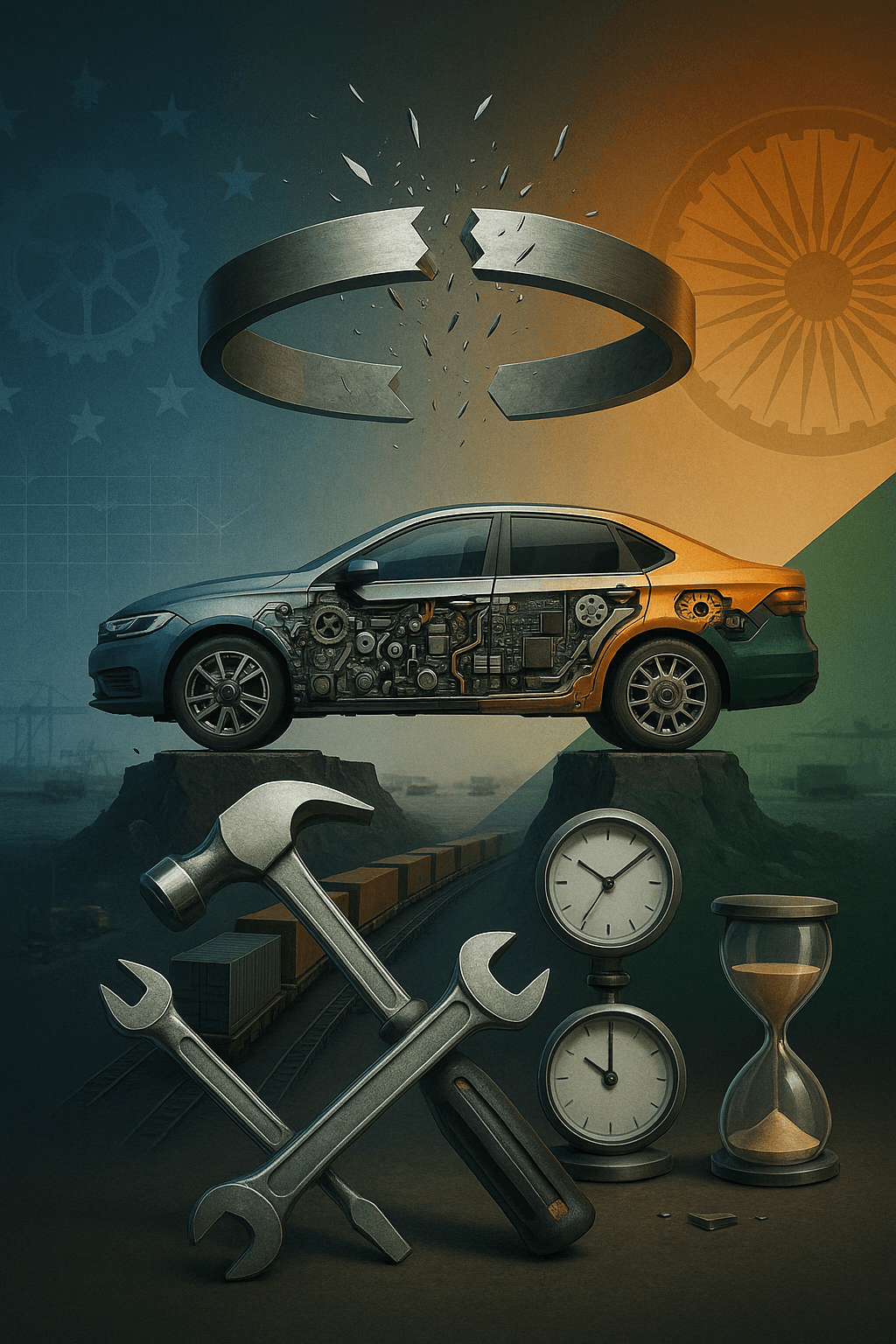
On January 27, 2026, the European Union and India signed a free trade agreement covering roughly 90% of goods and services. For the automotive sector it’s seismic: tariffs that can fall from about 110% to 10% over a 5–10 year glide path, with an annual quota capped at 250,000 vehicles. The first tariff effects are expected before the end of 2026.
If you run an industrial SME, are an auto-tier subcontractor, import components, or you’re a CIO responsible for supply-chain visibility, this isn’t "just geopolitics." It’s a new competitive arena — and a timing-sensitive one.
The SME Opportunity
On paper the benefit is straightforward: access lower-cost Indian sourcing and potentially reduce procurement costs across components closely tied to automotive production: mechanical parts, specialty chemicals, electrical systems, and machine tools.
The real business play is calendar-driven: initial tariff reductions arrive as early as 2026–2027, well before the full phase-down completes. Concretely, an SME can:
- Hedge country risk by adding India as an alternative (a deliberate China diversification strategy);
- Renegotiate supplier contracts using an explicit tariff trajectory instead of reacting to ad hoc price moves;
- Buy time on lead times by locking production and logistics capacity earlier in the cycle;
- Move upmarket — if OEMs or Tier‑1s pressure you on cost and continuity, this corridor can become a commercial advantage.
In short: this isn’t simply "buying cheaper." It’s about reclaiming margin and strengthening operational resilience.
Watchouts
The deal is also operationally complex. Four recurring risk areas demand attention:
- Unclear timing: the 5–10 year phase-down lacks a public step-by-step schedule. Buy too early and you erode margins; buy too late and you miss a cost window.
- Quota = bottlenecks: the 250,000 vehicles/year cap can create supplier pressure and skew negotiations if demand concentrates on a few vendors.
- Carbon surcharges can wipe out gains: EU mechanisms may reintroduce a bill if upstream emissions are high, turning a tariff win into a net cost.
- Supplier mapping urgency: without visibility across tier‑2/3 suppliers, materials, emissions and capacity, constraints will surface at the worst time — in production, with customers waiting.
The classic trap is to treat this as a procurement-only issue. It’s not — it’s procurement + finance + operations + data.
The Compliance Point
Stick a Post‑it on this: CBAM (Carbon Border Adjustment Mechanism) has been active since 2026. It can apply to automotive imports and components and may convert a tariff advantage into a near‑tax if your sourcing is carbon‑intensive.
Practical implication: you must be able to document your supply‑chain footprint — reporting, supplier data and Scope 3 visibility — before it becomes an administrative and financial choke point in H2 2026.
Conclusion & Cohesium Support
This EU–India agreement creates a genuine competitiveness lever for SMEs in the automotive value chain — provided you don’t navigate it blind. The winning pairing is clear: cost scenarios (tariffs + logistics + carbon) and supplier mapping so you can decide fast without locking yourself in too early.
Rather than patching together spreadsheets, Cohesium AI can support you with a CBAM exposure audit and a supply‑chain modeling engagement: mapping potential Indian suppliers, simulating costs under tariff phase‑down scenarios, prioritizing suppliers, and building a decarbonization & reporting roadmap to implement before the end of H2 2026. We also deliver Custom Integration and Strategic Audits to embed outcomes into your procurement, finance and data platforms.
Contact us