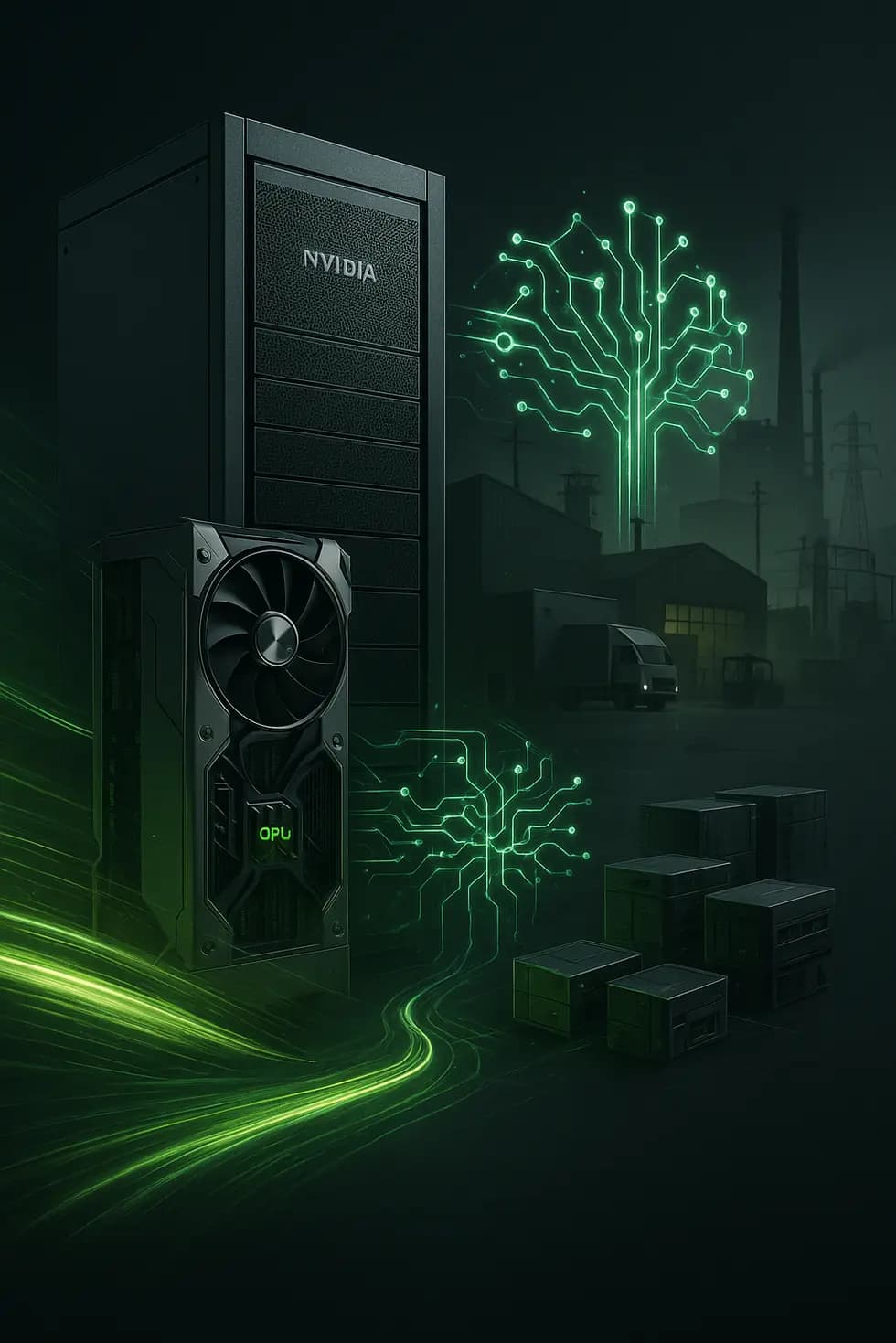
At GTC 2026, NVIDIA brought out the heavy machinery: a new server architecture, Vera Rubin, paired with Blackwell GPUs, an Enterprise AI software platform, and performance claims that turn heads. In plain English, the message is clear: if you want enterprise AI at scale, NVIDIA wants to provide the hardware, the software, and the operating model. This is especially relevant for SMEs, Mid-Market Enterprises, and IT leaders looking to industrialize AI without becoming fully dependent on public cloud.
The SME Opportunity
On paper, the value is obvious. First, performance. NVIDIA says its servers can handle much heavier AI workloads, with up to 35x more tokens in inference in certain scenarios. For a business, that means faster responses, smoother assistants, and AI agents that can execute business tasks without turning every request into an endless wait.
Second, data sovereignty. With on-premise and edge options, companies can keep sensitive data close to home: in the factory, the warehouse, the logistics site, or the internal data room. Less reliance on hyperscalers, fewer data flows crossing the globe, and tighter control over latency. For mission-critical use cases such as robotics, quality inspection, predictive maintenance, and field support, the ultra-low latency promised by certain edge solutions can be a real game changer.
Last but not least: the hybrid model. An SME does not necessarily need to bring everything back in-house. It can keep sensitive data and critical workflows on-premise while calling on more powerful cloud models for compute-intensive tasks. Properly orchestrated, this delivers the best of both worlds: confidentiality on one side, raw performance on the other.
The Caution Flag
But beware the “magic box” illusion. The first risk is lock-in. NVIDIA’s ecosystem is incredibly coherent — and therefore potentially very closed. Proprietary CPUs, an integrated software stack, dedicated networking: everything is designed to work well together. Great. Until the day you want to move out of that framework, migrate, or interoperate with a more traditional existing stack.
Second issue: complexity. This kind of infrastructure is not deployed like a small VM in the cloud. It requires DevOps, MLOps, networking, security, monitoring, and real architectural governance. Without that foundation, the AI project risks becoming an expensive demo instead of a production-grade business tool.
Finally, there is the bottom line: cost. NVIDIA has not released all pricing details, and the standalone configurations with liquid cooling and large CPU footprints are not toys. Before buying, you need to compare the real TCO against cloud or sovereign alternatives, and factor in the migration from older architectures.
The Compliance Angle
As soon as you talk about local storage, edge computing, and autonomous AI agents, compliance becomes non-negotiable. If your data stays in Europe or Switzerland, you gain more control. But you still need to verify exactly where the servers are hosted, what the contracts include, and how encryption, portability, and reversibility are handled.
GDPR and Switzerland’s nFADP apply if your processing involves personal data. And once agents start making decisions or automating actions, the EU AI Act becomes a real governance issue: documentation, traceability, risk controls, and human accountability. In short: infrastructure is not enough. You also need the evidence trail.
Conclusion & Cohesium Support
NVIDIA is pushing a compelling vision: faster, more sovereign enterprise AI that is less dependent on public cloud. But between performance promises and technology dependence, the decision must be made methodically. Rather than improvising, Cohesium AI can support you with AI audits, hyperscaler versus on-premise comparisons, TCO analysis, data governance, and GDPR/nFADP and AI Act compliance. We can also help you design a realistic hybrid architecture, with a clear roadmap and managed risk. Contact us