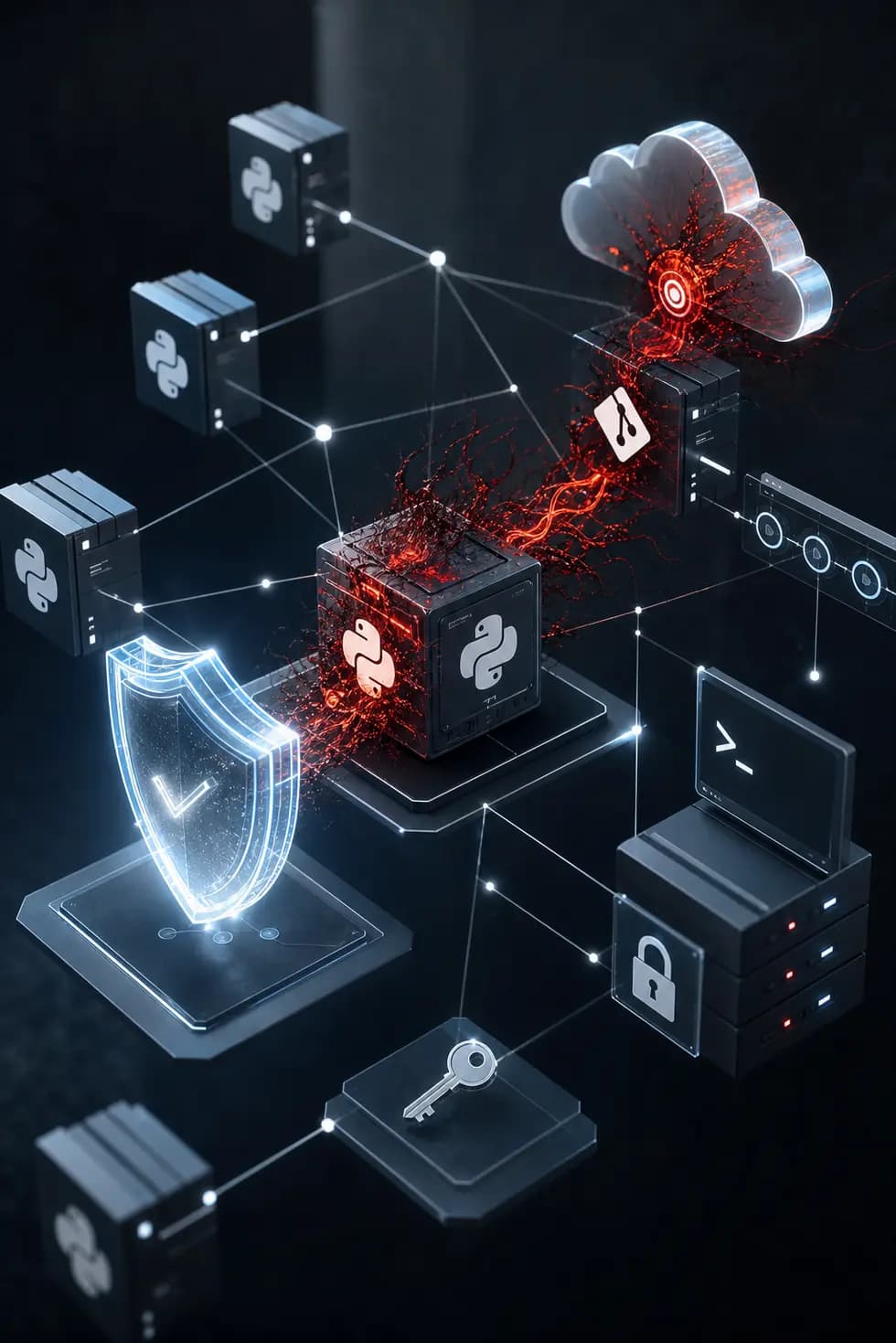
The Miasma campaign, also referred to as Shai-Hulud/Hades depending on the variants tracked by researchers, has crossed a new threshold: after npm, it spread to GitHub and PyPI. In practical terms, legitimate Python packages were poisoned with malicious versions capable of stealing cloud secrets, GitHub tokens, SSH keys, and sensitive configuration files. For an SME, IT services firm, or software vendor, the message is simple: if your product, CI/CD pipeline, or data projects rely on Python, you are potentially in the blast radius.
The SME Opportunity
Yes, a supply chain attack is bad news. But it is also a powerful catalyst for maturity. This incident is finally forcing teams to industrialize what they have postponed for far too long: dependency inventory, version locking, provenance checks, and secret rotation. In plain terms, you gain faster response times and stronger resilience.
Putting an SBOM in place, for example, is not just about looking good in an audit. It gives you immediate visibility into where a compromised dependency is used, across which clients, and in which environments. Add stricter pipelines, pinned versions, and alerts on removed or suspicious packages, and you turn a weak point into a commercial advantage: you can prove to an enterprise buyer that your software supply chain is under control.
For AI and data teams, the payoff is even clearer. Python libraries are everywhere in machine learning, deep learning, and automation. Formalizing an AI dependency policy, with an allowlist and review before adoption, prevents teams from bringing in third-party building blocks "because they work" without properly assessing the risk.
Where to Stay Alert
The trap is believing a standard vulnerability scanner will be enough. Miasma does not rely on public CVEs: in some versions, the packages were malicious from day one. In other words, if your detection only looks for known vulnerabilities, you have a major blind spot.
Another watchout: implementation has a cost. Keeping an SBOM current, hardening CI/CD runners, pinning GitHub Actions to specific commits, monitoring .pth files or unusual installation scripts, then orchestrating secret rotation... all of this requires tooling and governance. Without support, teams may see it as yet another layer of friction. And if you outsource security to overly opaque SaaS tools, be careful about technical and legal lock-in.
The Compliance Angle
If your systems process personal data, the issue goes far beyond IT. Stolen secrets can open access to customer databases, cloud environments, or tools containing sensitive information. In that case, you may be facing a data processing security issue under GDPR and the Swiss nLPD, with a potential incident-notification obligation depending on severity. For IT services firms and software vendors, mastering the software supply chain is also a contractual issue: clients are increasingly demanding guarantees around the provenance and security of third-party components.
Conclusion & Cohesium Support
The message is clear: the risk no longer comes only from the code you write, but from everything you import. Instead of piecing things together, Cohesium AI can audit your open source dependency chain, map your SBOM, secure your CI/CD pipelines, automate suspicious package detection, and support custom integration and strategic audits for your software supply chain. If you want to turn this topic into a competitive advantage rather than a reputational incident, Contact us