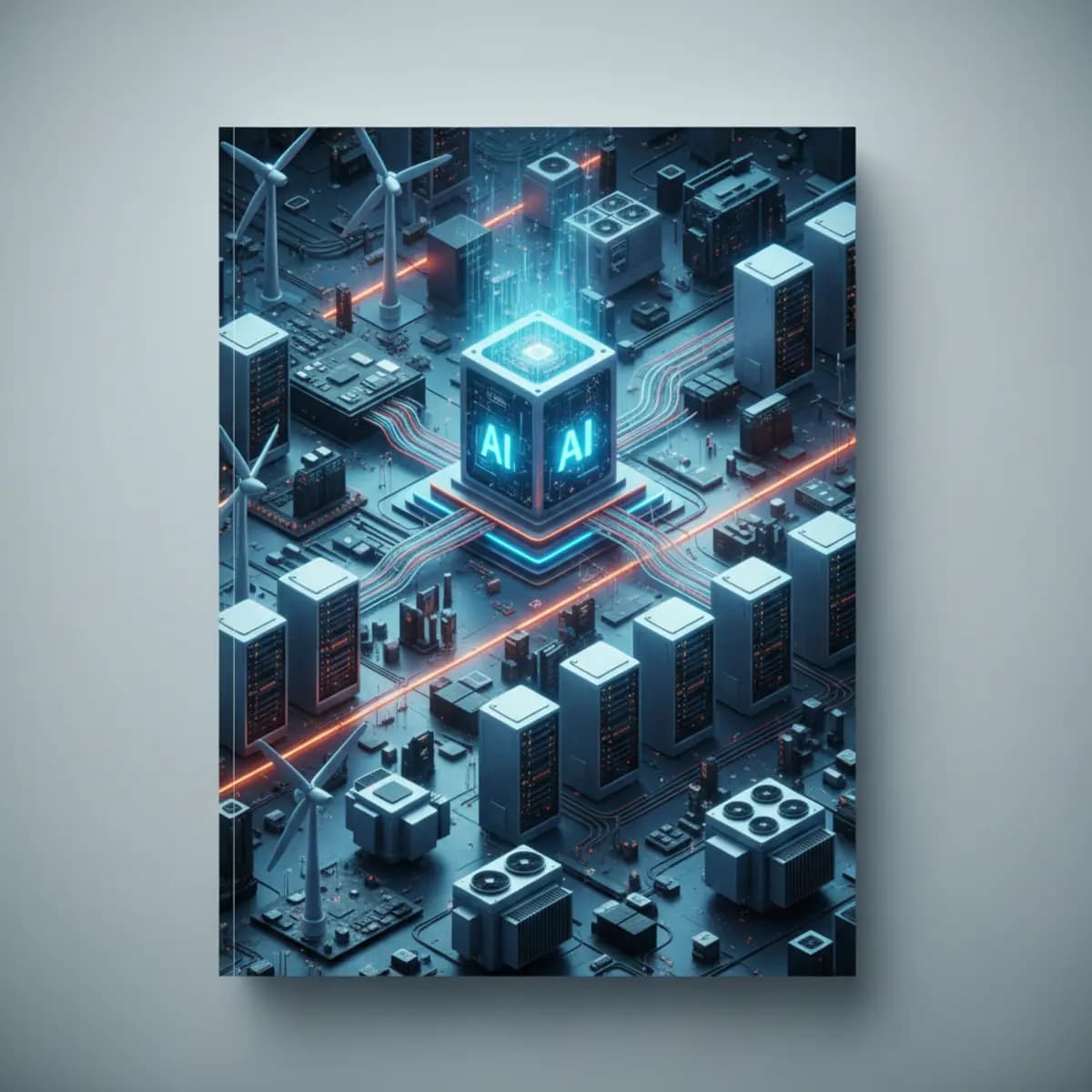
The market signal is now brutally clear: the major cloud and AI players are set to pour between ? billion and ? billion into capital expenditures in 2026. The business takeaway? Capital is shifting hard toward the rails that power AI: data centers, compute, energy, orchestration, cooling, components, and deployment. This article is for tech SME leaders and CIOs asking where to position themselves so they are not left behind as the train accelerates.
The core issue is simple: investors are no longer just asking, “Who has a good idea?” They are asking, “Who is solving a real bottleneck?” And in 2026, the bottleneck is not inspiration. It is the physical capacity to run AI at scale.
The SME Opportunity
For SMEs, the good news is that this race is creating highly profitable entry points. If your company sits anywhere in the AI infrastructure value chain, you are entering an area of exponential demand: components, integration, energy optimization, deployment services, cloud observability, orchestration middleware, and tools that reduce total cost of ownership.
Why does this matter? Because large-scale projects are already running into power shortages and critical component constraints. When half of data center builds are delayed or stalled, there is naturally room for more agile players who can deliver locally, faster, or with a stronger performance-to-cost ratio.
In plain terms: an SME that helps clients consume less energy, deploy closer to users, or manage inference costs more precisely can become far more visible than yet another “AI-powered” software vendor with no real technical depth. The market likes promises; 2026 venture capital wants proof of traction in infrastructure.
The Watchout
The downside is less glamorous: pure software players without a strong technical foundation risk becoming invisible. Today, software with no execution advantage, no infrastructure layer, and no meaningful technical differentiation can be overtaken by competitors in a matter of months. Worse, if it depends entirely on a hyperscaler to run, it is exposed to price increases, contractual constraints, and capacity trade-offs.
Another trap is confusing a hot market with a financeable business. Physical constraints slow down monetization. If your roadmap assumes rapid scale, but your supply chain, compute capacity, or deployment partnerships cannot keep up, your VC narrative will collapse at the first serious due diligence.
The right move is not to do “AI” for the sake of AI. The right move is to choose your position in the value chain and prove a real contribution to a measurable problem: power, latency, TCO, reliability, technical sovereignty, or deployment speed.
Conclusion & Cohesium Support
In 2026, the venture capital battle will not be won on software polish, but on the ability to build, optimize, and monetize AI infrastructure. For an SME, the question is no longer “How do we add an AI layer?” It is “Where can we create a defensible advantage in the technical stack?”
Rather than improvising, Cohesium AI can support you with a strategic audit & AI infrastructure roadmap: value-chain positioning, hardware/software/middleware trade-offs, TCO analysis, partner targeting, and VC fundability framing. If your project involves hosting or inference, we can also help map the right regions and vendors.
The right move is not to be “in AI.” The right move is to be indispensable to its deployment. Contact us