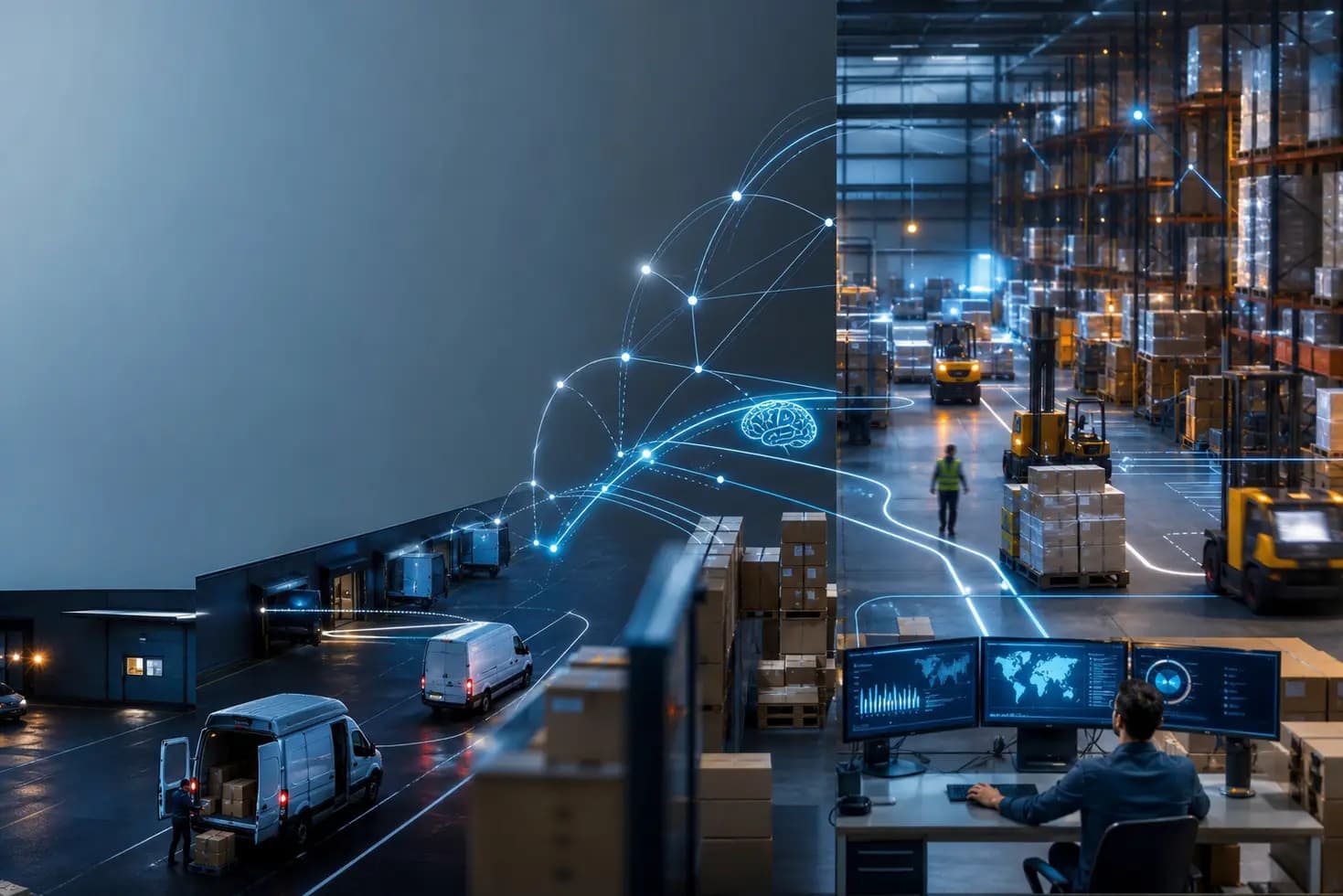
Everyone talks about AI in the office. Far fewer talk about it in the warehouse. Yet supply chain is where AI becomes immediately tangible: inventory, transportation, route planning, maintenance, demand forecasting... Recent studies show that roughly 50% to 56% of supply chain software buyers have already integrated AI modules into their TMS, WMS, or fleet management tools. In other words, this is no longer a nice experiment to showcase in the boardroom. It is becoming the new standard.
The SME Opportunity
For an industrial, logistics, or distribution SME, the signal is clear: AI can save time, reduce errors, and absorb volatility without driving costs through the roof. In practical terms, it already automates data collection and processing, improves workflow reliability, supports demand forecasting, and optimizes inventory, routes, and transportation planning.
The real value is not 'having AI' on the sales deck. It is reducing the operational friction that eats into margin: manual data entry, stockouts, late deliveries, poor vehicle allocation, and decisions made too late. Properly configured, AI improves real-time visibility across flows and helps teams make better decisions faster. For an SME, that can translate into tighter delivery performance, fewer order errors, and a more stable organization during peak demand.
The key point: software vendors themselves recommend starting with a process and data audit. That is good news, because it allows companies to prioritize high-return use cases first, where ROI is measurable before moving on to more ambitious initiatives.
The Risk to Watch
The flip side is hidden complexity. Many solutions are marketed as 'plug-and-play,' but in the real world, logistics AI never makes up for poor data quality. If the information is incomplete, inconsistent, or outdated, the model may optimize... in the wrong direction.
Another risk is lock-in. When AI modules are embedded in a proprietary way inside a TMS or WMS, it becomes much harder later to switch vendors or evolve the architecture without friction. And the more AI components you add, the more you need to think about orchestration between ERP, WMS, TMS, and fleet tools. Otherwise, you automate silos instead of automating the chain.
Change management also matters. Teams need to understand what the tool recommends, why it recommends it, and where human oversight still applies. Without clear governance, AI becomes just another gadget, not a performance engine.
The Compliance Factor
In supply chain operations, AI often handles traceability, geolocation, and performance data. At that point, the issue is no longer just technical. It becomes regulatory. For companies operating in the EU, GDPR requires a clear legal basis, data minimization, transparent notice to data subjects, and in some cases a Data Protection Impact Assessment before deployment. In Switzerland, the nFADP also requires proportionality, security, and transparency.
Hosting choices matter too. Depending on the use case, it may be smart to prioritize local regions or providers such as OVHcloud, Scaleway, Infomaniak, Exoscale, or Hidora to better control data flows and secure the contractual framework.
Conclusion & Cohesium Support
AI is no longer a bonus in supply chain operations. It is becoming the baseline. SMEs that move early gain visibility, responsiveness, and resilience. Those that wait risk being left with slower, more expensive, and less reliable processes than their competitors.
Rather than patching things together, Cohesium AI can audit your supply chain processes, map your high-ROI use cases, automate workflows across ERP, TMS, and WMS, and secure your logistics data with a GDPR/nFADP approach tailored to your on-the-ground reality. Contact us