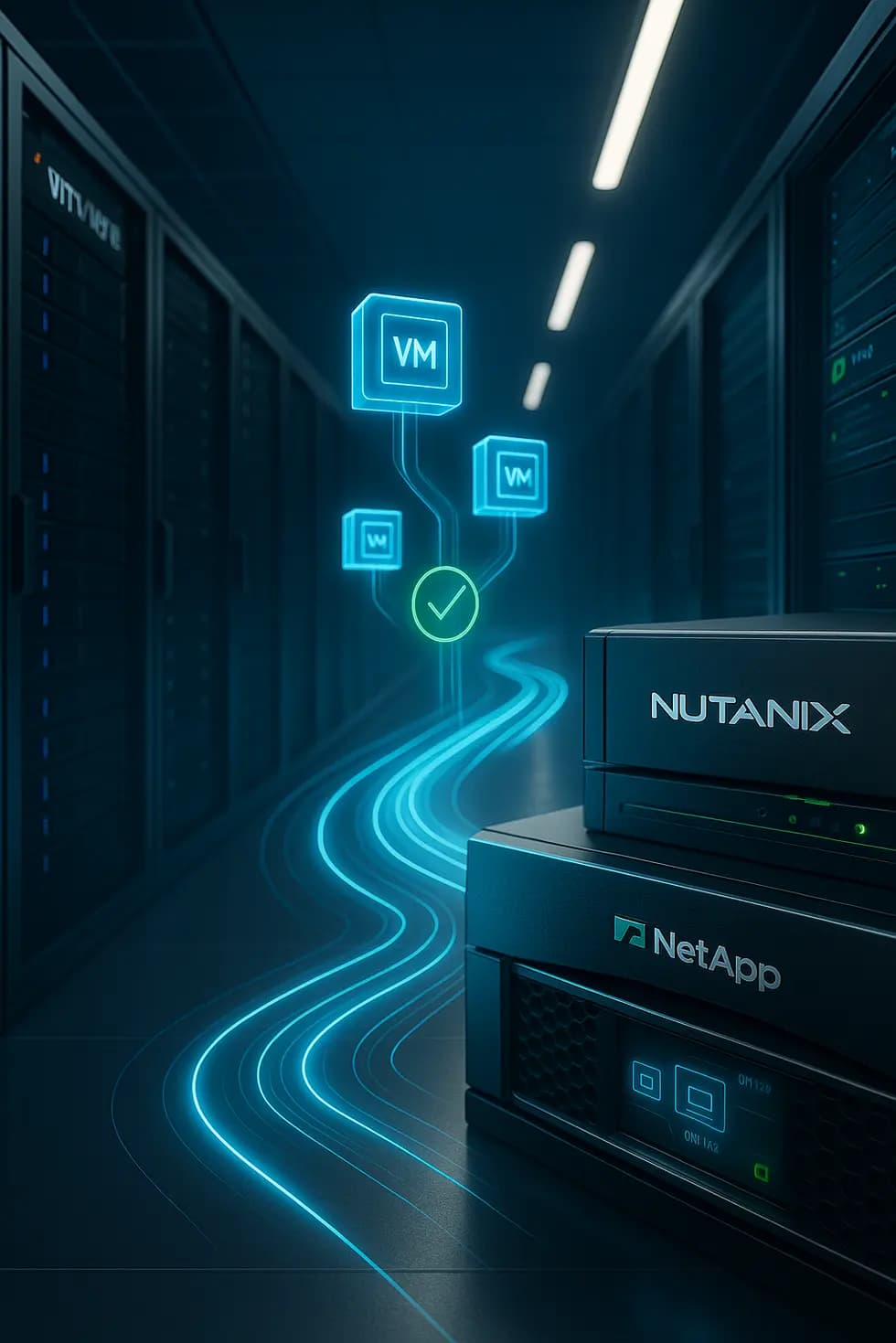
The Nutanix and NetApp duo has just announced an integration that speaks directly to CIOs and business leaders at SMEs and mid-market companies: making it possible to run the Nutanix Cloud Platform alongside NetApp ONTAP storage, while keeping the AHV hypervisor. The idea is easy to summarize: make a VMware migration far smoother without throwing away the infrastructure already in place. For companies already running NetApp, this is a strong signal. For those looking for a credible VMware alternative, it could be a powerful shortcut.
The SME Opportunity
The first benefit is obvious: time. Where a cold migration can take weeks and disrupt operations, the announced approach promises virtual machine transfer in minutes via NFS, NetApp Shift, and Nutanix Move. In business terms, that means less production downtime, less pressure on IT, and fewer emergency consulting costs.
The second advantage is investment continuity. Many SMEs have already paid for their NetApp storage and have no appetite for starting from scratch just because the VMware ecosystem is shifting. Here, the goal is not to tear everything down and rebuild it, but to modernize in controlled layers.
Another key point is unified management through a shared control plane. Fewer consoles, less manual work, fewer human errors. For an SME, this is often where the real ROI is found: not only in license or hardware savings, but in the hours reclaimed by the infrastructure team.
Finally, the integration of cyber-resilience capabilities, including AI-assisted ransomware protection on the NetApp side, adds a valuable security layer. And the roadmap toward Nutanix Agentic AI shows that the infrastructure is not designed only to “run VMs,” but also to support early AI use cases without redesigning the architecture six months later.
The Caution
The main drawback is the timeline: commercial availability is announced for late 2026. In other words, this is not a magical solution you can deploy tomorrow morning. You still need time to budget, test, secure dependencies, and plan the migration properly.
Second caution: integration complexity. A partnership between two major vendors is reassuring on paper, but it is still a technical project that will require specialized expertise. If your IT team is already stretched thin, outside support should be factored in early.
Finally, vendor dependency risk remains. You may reduce VMware lock-in, but you do not eliminate vendor dependencies altogether. There are also still gray areas around older ONTAP versions and certain hybrid configurations. In short: the proposal is promising, but it needs to be validated against your real-world environment.
The Compliance Angle
The issue touches an infrastructure that may combine on-premises and cloud environments, but there is no clear detail yet on hosting regions or data residency. For a US-based company operating internationally, or for any organization subject to strict data governance rules, this is something to audit before committing: where does the data go, in which country, and under what guarantees? If you are aiming for sovereignty requirements or regulated environments, you need to confirm whether your hosting and architecture choices align with your internal policies and customer obligations.
Conclusion & Cohesium's Support
Nutanix + NetApp looks like a real exit path for companies that want to leave VMware without weakening their technical foundation. But between the announcement and production deployment, there is the real-world layer: compatibility, compliance, budget, AI roadmap, and acceptable risk level.
Rather than improvising, Cohesium AI can support you with a VMware → Nutanix + NetApp transition audit: AI strategy, compliance and data validation, and operational migration analysis, with a tailored roadmap delivered in 3 to 5 days.