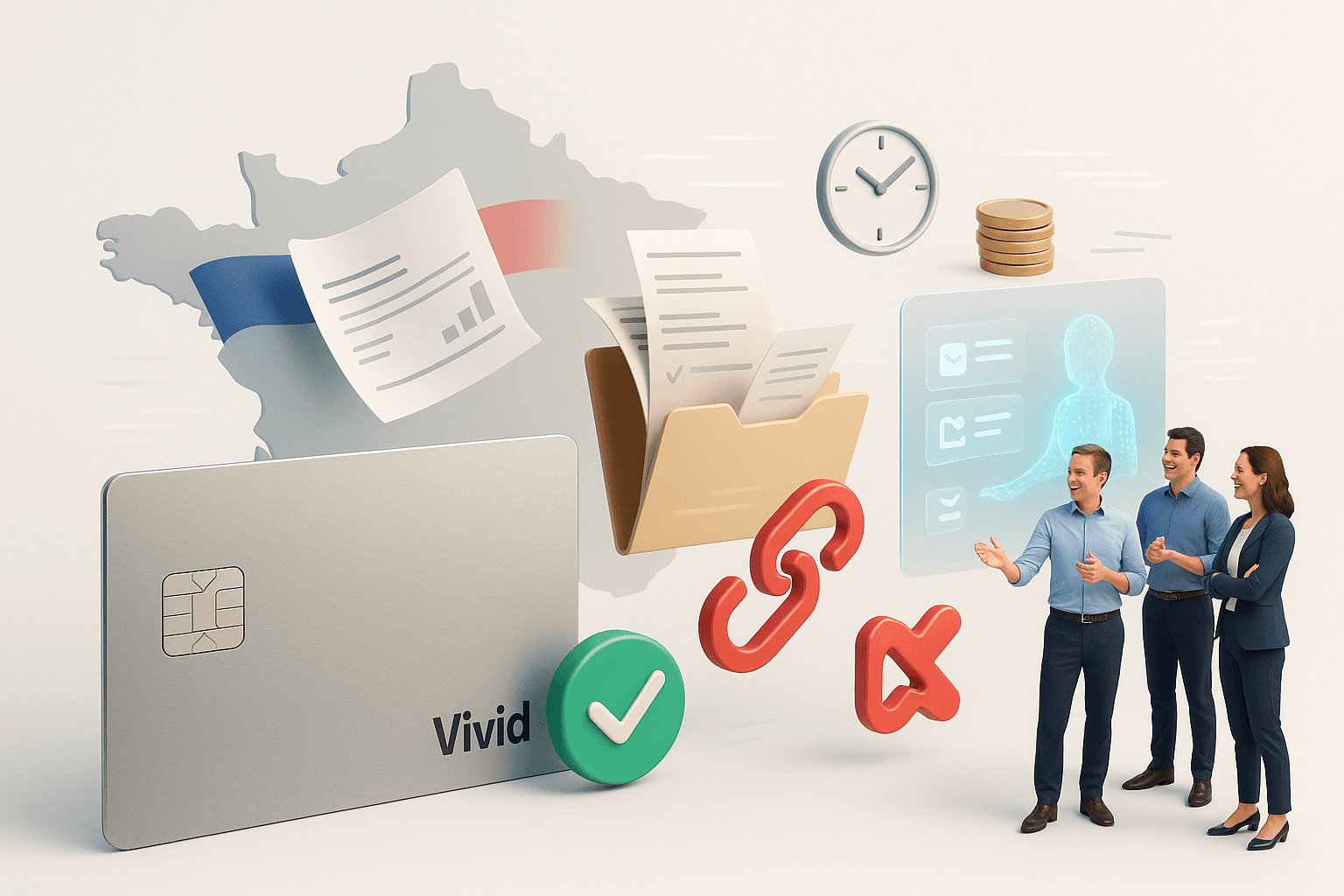
Vivid, the European challenger bank founded in 2019, is accelerating in France with a very pragmatic update: a French IBAN launched in December 2025. For SMEs this isn’t a marketing trinket — it’s often the difference between “it works” and “it breaks” for direct debits, transfers, and credibility with partners. On top of that, Vivid is pushing AI assistants (including Emma, a financial assistant) designed to automate admin, treasury and even some contract tasks. Promised impact: +30% productivity, 13 hours saved per week, and up to €4,000 in monthly savings (their figures).
The SME Opportunity
1) French IBAN: end of “IBAN discrimination” and painful rejections.
If you’ve had a supplier refuse a foreign IBAN, or recurring debits that stall, you know this is not just a banking issue — it’s a cash flow and mental-load issue. A FR IBAN reduces operational friction (delays, rejects, reluctance) and restores the “traditional bank” perception.
2) AI as a “digital employee”: interesting — if your processes are repeatable.
The ROI shows up on routine work: document sorting, export preparation, cash monitoring, reminders, and executive summaries. For a team of 3 to 5 people, a claimed €4,000/month saving can be a meaningful lever — provided the tool fits cleanly into how you operate.
3) An aggressive commercial package to trial with low friction.
Vivid highlights a free checking account, multiple IBANs included, up to 10% cashback, and a promotional rate of 4% for four months (terms not detailed here). That lowers adoption friction versus a traditional business account.
What to Watch For
1) AI lock-in: the assistant that “helps” can become a dependency.
The assistants (Emma, Alex & co) carry disclaimers: they are not “professional advice.” The core risk is portability: if your workflows, habits and decisions pass through a proprietary layer, exiting later can be costly — in time, data migration and organizational disruption.
2) Fintech vs. bank: regulation does not equal comfort.
Vivid operates under supervision (European entity and references to Luxembourg and the Netherlands), but it remains a fintech. For some leaders the question isn’t “is it legal?” but “will I sleep well with this for my treasury?”
3) Integration: the real hidden cost.
Onboarding AI means changing habits. Without clear guardrails (roles, approvals, exceptions, who controls what), AI generates noise rather than value. The best results come from standardizing 5–10 simple processes before pursuing “full transformation.”
4) Sensitive data: a grey area.
Data residency and processing of financial and administrative information are not specified. We could be talking about treasury, HR and contracts — that’s critical.
Compliance Angle
This squarely touches GDPR (and the Swiss data protection update, the nLPD, if you handle Swiss data), because the AI assistants will process financial, administrative and potentially HR data. Even with a European provider, verify: what data is sent where, who the subprocessors are, retention periods, and transfer mechanisms if any components leave the EU. Note: the absence of a clear hosting region (e.g., OVHcloud, Scaleway, Exoscale, Infomaniak, Hidora, etc.) should trigger an immediate audit reflex.
Conclusion & Cohesium Support
Vivid checks two boxes that matter to an SME: streamlining operations (French IBAN) and reducing administrative burden (AI assistants). But the real value depends on execution: avoiding lock-in, framing your processes, and securing sensitive data flows.
Rather than patching things together, Cohesium AI can support you with a concrete offer: AI Compliance Audit + n8n Workflow Migration to Optimize SME Treasury. Objective: map your flows (bank/ERP/invoicing), validate GDPR/nLPD compliance, then automate cleanly (reconciliations, exports, alerts, reporting) with controlled, documented workflows.
If you prefer, we can schedule a brief strategic conversation to assess risk, governance and ROI — whether that’s a tailored integration or a focused compliance audit.
Contact us